Scotland’s witch trials, 1563–1736

What was witchcraft?

Where the idea came from, what people truly believed, and how ordinary neighbours came to be named as witches. Every fact carries a number that matches its source at the foot of the page. This is the true history beneath the saga.

I · Where the idea came from

From charm to crime

For centuries, people in Scotland lived alongside healers, charmers who cured with spoken spells, and stories of the fairies. Then, in 1563, the law changed, and belief became a hunt.

What historians think

The belief that some people could heal or harm by hidden means is very old, and is found all over the world.1

What historians think

Historians no longer believe the accused followed a secret pagan religion older than Christianity. The Survey of Scottish Witchcraft found no evidence of any organised witch cult.2

What historians think

In the late Middle Ages, learned writers added something new: that witches flew to night meetings and had sworn themselves to the Devil. Magic became a crime against God.13

What historians think

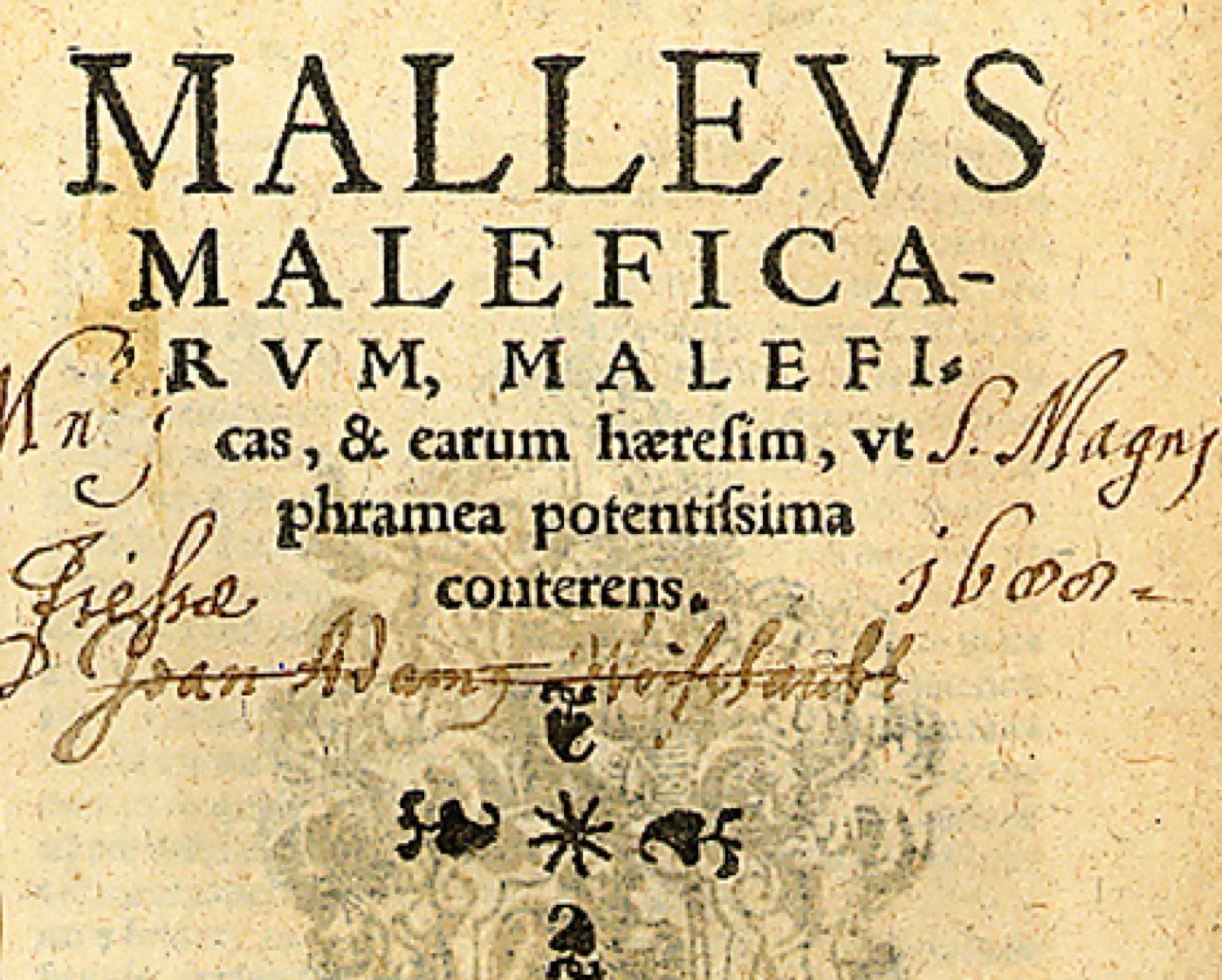
The Malleus Maleficarum (‘The Hammer of Witches’), written by the German Dominican friar Heinrich Kramer, was first printed in 1486–87. It was never the Catholic Church’s official teaching.14

What historians think

In 1560, at the Reformation, Scotland broke with the Pope and became Protestant. The Kirk, as the new Church of Scotland was called, and the Crown then set out to build a godly nation. Sin left unpunished, they feared, would bring God’s anger down on everyone.53

From the records

James VI questioned suspects himself in 1590–91, then wrote his own book on witches and demons, Daemonologie, in 1597.26

The Hammer of Witches

The title page of a 1520 edition of the Malleus Maleficarum.

The King’s own book

The title page of Daemonologie, in its London edition of 1603.

A short history, 1486 to 2022

  1. 1486–87

    The Malleus Maleficarum, a handbook for hunting witches, is printed in Germany.1

  2. 1563

    Scotland’s Witchcraft Act makes witchcraft a crime punishable by death. It never says what a witch is.7

  3. 1576

    Bessie Dunlop, in Ayrshire, south-west Scotland, tells her judges that a ghost taught her to heal.8

  4. 1588

    Alison Pearson of Byrehill, in Fife, across the Forth from Edinburgh, describes the court of the fairy queen at her trial.9

  5. 1590–91

    Storms that threaten the King’s ships are blamed on witches, and the North Berwick trials begin.2

  6. 1597

    James VI publishes Daemonologie, in a year of fresh panic.62

  7. 1628–30

    Another wave of trials sweeps through the Lowlands of southern Scotland.2

  8. 1643

    Six Dunfermline women are burned as witches.10

  9. 1649

    A new national panic begins.2

  10. 1661–62

    One of the most intense hunts in Scotland’s history.24

  11. 1727

    The last known execution, at Dornoch, in the far north.11

  12. 1736

    The Witchcraft Act is repealed.2

  13. 2022

    Scotland’s First Minister apologises.12

II · What people believed and did

Charms, herbs and the fairy court

Most of the accused were ordinary neighbours, living in a world full of charms, cures and fairies. Here is some of what they believed.

From the records

Bessie Dunlop of Lyne, in Ayrshire, told her judges in 1576 that a dead man called Thom Reid, sent by the Queen of Elfame, ruler of the fairy realm, had taught her to heal with herbs. He first came to her, she said, when her cow had died and her husband and newborn child lay sick. She was found guilty and sentenced to death.8

From the records

Alison Pearson of Byrehill, in Fife, was tried in 1588. She spoke of the fairy court, its queen, and a spirit called William Simpson, who taught her to cure the sick. She too was condemned.9

From the records

In Daemonologie (1597) James VI complained of charms made by ‘knitting rowan trees’, the mountain ash, to the hair and tails of farm animals.6

Folklore

Customs such as iron over the door to keep fairies out, or holed ‘witch-stones’ hung up to protect cattle, were mostly written down in the 1800s and early 1900s, long after the trials.13

What historians think

Doctors were few. When a cow sickened, a harvest failed or a child was dying, people wanted a reason, and witnesses often told of a quarrel with the accused, followed by a misfortune.2

From the records

Healing appears in the cases of 141 of the accused, about four in every hundred. Most people accused of witchcraft were not healers or midwives.2

A charm against toothache

Written in Scotland between 1860 and 1880 for a woman named Mary McLeod to wear round her neck, and later given to a museum by a churchman from Mull. Belief in charms outlived the trials by more than a century.

III · What they were accused of

The case against them

These cards record what was claimed, not what happened. Many confessions were forced: the 1591 pamphlet, News from Scotland, itself tells how Agnes Sampson’s head was wrenched with a rope.14 The charges were written out in a dittay, the Scots word for an indictment. Agnes Sampson’s ran to 102 items; an English diplomat reported that she admitted 58.1516

  1. The first nameA pamphlet’s account

    It began, News from Scotland says, in Tranent with Geillis Duncan, a maidservant who had started curing the sick. Her master, David Seaton, the town’s deputy bailiff, had her tortured with thumbscrews and a cord twisted round her head. She confessed and named others, among them Agnes Sampson and Euphame MacCalzean.17

  2. Not only the poor

    Euphame MacCalzean, the only daughter and heiress of the judge Thomas MacCalzean, Lord Cliftonhall, was questioned at Holyrood in May 1591. On 15 June she was condemned to be burned alive on Castlehill, without the usual mercy of strangling first.18

  3. Healing

    Agnes Sampson was a folk healer who helped women through childbirth. Her care for them was turned into evidence against her.16

  4. The Devil’s mark

    Searchers looked for a mark the Devil was said to leave on his followers’ skin. The 1591 pamphlet says one was found on Geillis Duncan’s throat; the court records note one on Agnes Sampson’s knee.1416

  5. Raising stormsA pamphlet’s account

    The confessions say the witches sailed out ‘in a riddle or sieve’ and threw a christened cat into the sea off Leith, Edinburgh’s port, to raise a storm against the King’s ship.14

  6. The toad and the wax kingA pamphlet’s account

    Agnes Sampson confessed that she hung a black toad up by its heels to collect the venom. Others were accused of making figures of the King in wax.1418

  7. The kirk at North BerwickA pamphlet’s account

    At the kirk (Scots for church), the accused said, the Devil was waiting ‘in the likeness of a man’.14

  8. In the King’s words

    Daemonologie claims witches could raise storms, waste a victim away by roasting a figure of wax, and pass sickness from one person to another.6

IV · What was forced

How a confession was made

From the records

Most cases began with a complaint to the kirk session, the parish church court of minister and elders. It could question suspects and gather neighbours’ evidence, but it had no power to try or execute anyone, so it passed cases on to the Privy Council or Parliament.25

From the records

The Privy Council, the King’s council, did not try witches itself. It issued ‘commissions of justiciary’, letting local men hold a trial, usually for one accused person. Most accused Scots were tried this way, and few of these courts’ records survive.2

From the records

Torture was used to win confessions, often without the permission the law required. The commonest form was keeping suspects awake for days on end, which can bring on hallucinations.25

What historians think

Neighbours mostly spoke of quarrels and everyday harm. It was the questioners who asked about the Devil, which is why a pact or a meeting with him appears in most detailed confessions.52

‘I shall go into a hare, with sorrow and sigh and mickle care.’

Isobel Gowdie, under interrogation at Auldearn, 3 May 166219
What historians think

The historian Emma Wilby argues that the 1662 confessions of Isobel Gowdie, a farmer’s wife from Auldearn, near Nairn, may mix her own visions with answers shaped by leading questions.20

  1. From the records In the great hunts, suspects were asked to name their accomplices.2
  2. A pamphlet’s account In 1590 one frightened maidservant gave names.17
  3. Two of them were a healer, Agnes Sampson, and a judge’s daughter, Euphame MacCalzean.1718
  4. From the records Agnes Sampson, in her turn, named 59.16
  5. One confession. Then the names spread.

V · Grief, age and difference

Who was most at risk

Historians are wary of diagnosing the dead. The records are clearer about who was in danger: the old, and those who had quarrelled with their neighbours. Some historians add the bold.

What historians think

The historian Julian Goodare has studied Scots, most of them women, who said fairies or ghosts guided them. Drawing on modern medicine and psychology, he argues that some of them may have had conditions such as sleepwalking, mutism or catatonia.21

From the records

About half of the accused whose age is known were over forty, at a time when lives were shorter. Of those whose place in society is known, most were neither rich nor the very poorest.2

What historians think

Writers at Historic Environment Scotland, which looks after the nation’s heritage, have suggested that the last woman executed, remembered as Janet Horne, may have been living with dementia. It is a suggestion, not a diagnosis.22

From the records

The Survey found no evidence in Scotland for the popular idea that mouldy, poisoned grain caused the witches’ visions.2

VI · Who was accused, and how it ended

Counting the accused

From the records

In all, 3,837 people are known to have been accused of witchcraft in Scotland between 1563 and 1736. About 84% were women.2

What historians think

Across Europe, about three in four of the accused were women; in Scotland the share was higher still. Accused women may have been seen as having ‘smeddum’: a spirit and boldness at odds with how women were expected to behave.411

From the records

The sentence is known in only 305 cases, so no one knows how many were put to death. Of the 141 sentences that record how someone was to die, 120 specify strangling at the stake, then burning. In England, where witchcraft was a felony, a serious crime like murder, the condemned were hanged.223

From the records

The woman put to death at Dornoch in 1727 is known as Janet Horne. Her memorial stone gives the year as 1722.1122

From the records

The Witchcraft Act was repealed in 1736, when the British Parliament scrapped the English Act too. Witchcraft became the lesser crime of pretending to practise it.211

From the records

On 8 March 2022 Scotland’s First Minister, head of its government, apologised ‘to all of those accused, convicted, vilified or executed’. It followed Witches of Scotland, a campaign launched in 2020 by the lawyer Claire Mitchell KC and the writer Zoe Venditozzi. There is still no pardon.12242526

From the records

The numbers on this page come from the Survey of Scottish Witchcraft, compiled at the University of Edinburgh in 2001–03. Its team spent nearly nineteen months in the National Archives of Scotland, building on Christina Larner’s source book of 1977.27

Every mark was a person.

Each of these 3,192 marks is a named person in the Survey’s records, set in the earliest year their case is dated. Hundreds more were never named.

    The numbers by decade
    DecadeNamed accused
    1560s41
    1570s43
    1580s31
    1590s244
    1600s46
    1610s105
    1620s403
    1630s230
    1640s641
    1650s373
    1660s641
    1670s192
    1680s26
    1690s113
    1700s50
    1710s11
    1720s2

    The Survey’s full count of 3,837 also includes people never named or never dated.

    Data: Survey of Scottish Witchcraft, 1563–1736 (Goodare, Yeoman, Martin and Miller, © University of Edinburgh, 2010), doi.org/10.7488/ds/100, CC BY 4.0. Adapted: named accused with a known year, each placed in the earliest year recorded for their case.

    VII · Warm or cold?

    Test what you have heard

    In the novel, Sorsha’s ring is warm for the truth and cold for the lie. Here, the records answer. Try it on seven things people say about witches. The ring is invented; every answer comes from the records and the historians who study them.

    1. 1Nine million people were executed as witches in Europe.

      What historians think A myth. Most historians estimate that between 40,000 and 60,000 people were executed for witchcraft across Europe.43

    2. 2Most people accused of witchcraft in Scotland were healers or midwives.

      From the records A myth. Healing appears in the cases of 141 of the accused, about four in every hundred.2

    3. 3Edinburgh ducked its witches in the Nor’ Loch.

      From the records Not as a witch test. In 1562 the town council did order a ducking place, with a pulley, in the loch, but it was for punishing fornicators.28

    4. 4About 84% of the people accused in Scotland were women.

      From the records True. Of the 3,837 people known to have been accused between 1563 and 1736, more than four in five were women.2

    5. 5The Malleus Maleficarum was the Catholic Church’s official teaching on witches.

      What historians think A myth. The book was written by a German friar and printed in 1486–87. It was never the Church’s official teaching.14

    6. 6Most Scottish witches who were put to death were strangled at the stake, then burned.

      From the records As far as the records show. 120 of the 141 sentences that name a method order exactly that.2

    7. 7Scotland has pardoned the people convicted of witchcraft.

      From the records Not yet. The First Minister apologised in 2022, but no pardon has become law.1226

    VIII · Where the story begins

    Then the story takes over.

    From the novel

    In the story, the Keepers risk their lives to care for others.

    Sorsha wears her mother’s iron ring. Warm for the truth. Cold for the lie.

    Morag is an Easer. She offers to take away suffering, wins people’s gratitude and turns it into control.

    The dead elders are called the Kept.

    The Fires We Carried, Book One and the Official Saga Summary

    You’ve read what the records say.

    Take the road north with you: a free walking map of the witch-trial sites, and first word when Book One is ready. About one letter a month.

    By joining you agree to the privacy notice. Leave whenever you like.

    Sources and credits

    How this site tells history from story

    • From the records what the documents say, with a numbered source.
    • What historians think interpretation by named historians.
    • Folklore belief and tradition, not evidence.
    • From the novel the story, always in gold and kept apart.

    Sources

    1. Historisches Lexikon Bayerns, ‘Persecution of witches’. Link
    2. Survey of Scottish Witchcraft, ‘Frequently asked questions’. Julian Goodare, Lauren Martin, Joyce Miller and Louise Yeoman, University of Edinburgh, 2003. Link
    3. Julian Goodare, The European Witch-Hunt (Routledge, 2016).
    4. Brian P. Levack, The Witch-Hunt in Early Modern Europe, 3rd edition (Pearson, 2006).
    5. University of Edinburgh, Witches in Scotland: introduction and trial procedure (built on the Survey’s data). Link
    6. James VI, Daemonologie (Edinburgh, 1597), Project Gutenberg edition (original spelling ‘knitting roun-trees’). Link
    7. Julian Goodare, ‘The Scottish Witchcraft Act’, Church History 71 (2002).
    8. Survey of Scottish Witchcraft, case of Bessie Dunlop (C/EGD/29), citing JC2/1 and R. Pitcairn, Ancient Criminal Trials in Scotland, vol. I (1833). Link
    9. Survey of Scottish Witchcraft, Alesoun Peirsoun (A/EGD/23, C/EGD/34); R. Pitcairn, Ancient Criminal Trials in Scotland, vol. I, part ii (1833), pp. 161–65 (the record’s margin notes ‘Convicta et combusta’). Link
    10. Ebenezer Henderson, The Annals of Dunfermline (1879), p. 309, citing the town’s Register of Deaths. Link
    11. Historic Environment Scotland blog, Ruth Schieferstein, Nikki Moran and Morvern French, ‘The Witchcraft Act and its impact in Scotland’, 10 June 2022. Link
    12. Scottish Government, First Minister’s statement of apology, 8 March 2022. Link
    13. J. G. Campbell, Superstitions of the Highlands and Islands of Scotland (1900).
    14. News from Scotland (London, 1591; original spelling ‘Newes from Scotland’), in the same Project Gutenberg edition. Link
    15. Dictionaries of the Scots Language, Scottish National Dictionary, ‘Dittay’. Link
    16. Survey of Scottish Witchcraft, case of Agnes Sampson (C/EGD/63). Link
    17. News from Scotland (London, [1591]), reprinted in R. Pitcairn, Ancient Criminal Trials in Scotland, vol. I, part ii (Edinburgh, 1833), pp. 213–23. Link
    18. R. Pitcairn, Ancient Criminal Trials in Scotland, vol. I, part ii (1833), pp. 247–57; Survey of Scottish Witchcraft, trial T/LA/995. Link
    19. Isobel Gowdie, second confession, Auldearn, 3 May 1662, in R. Pitcairn, Ancient Criminal Trials in Scotland, vol. III, part ii (1833), p. 607 (original: ‘I sall goe intill ane haire, With sorrow, and sych, and meikle caire’). Link
    20. Emma Wilby, The Visions of Isobel Gowdie (Sussex Academic Press, 2010).
    21. Julian Goodare, ‘Away with the fairies: the psychopathology of visionary encounters in early modern Scotland’, History of Psychiatry 31 (2020), 37–54. Link
    22. Historic Environment Scotland blog, Julia Morrison, ‘Disability History Month: remembering four historic Scots’, 5 December 2019. Link
    23. English Heritage, ‘Eight witchcraft myths’. Link
    24. Holyrood, ‘Nicola Sturgeon issues formal apology to historic victims of witchcraft allegations’, 8 March 2022. Link
    25. Witches of Scotland, ‘About us’. Link
    26. Scottish Government, FOI review: pardoning of witches. Link
    27. Survey of Scottish Witchcraft, ‘About the Survey’ (ESRC grant R000239234; building on C. Larner et al., A Source-Book of Scottish Witchcraft, 1977). Link
    28. J. D. Marwick (ed.), Extracts from the Records of the Burgh of Edinburgh, 1557–1571 (1875), p. 135.

    Pictures

    • Malleus Maleficarum, title page, Cologne edition of 1520 · University of Sydney copy, via Wikimedia Commons · Public domain
    • Daemonologie, title page, London edition of 1603 · Wellcome Collection · CC BY 4.0
    • Written charm against toothache, Scotland, 1860–80 · Science Museum, London / Wellcome Collection · CC BY 4.0